As a woman under thirty, even when I’m not traveling, I often feel in my everyday life that I can’t show when I am afraid or uncomfortable until I know I’m in a safe space. One of the scariest moments I’ve ever experienced on my travels alone occurred in the summer of 2012 when I was 19 and in Paris. I was staying with a group of friends who were attending Sciences Po. They were in their final exams for the semester, which meant I had the day to explore.
I was walking back to the apartment we were renting when I was approached by two young men from the opposite direction. They catcalled me in a language I didn’t fully understand and made rude gestures that I did. I didn’t respond. They moved to my side of the sidewalk, and as I passed, one stuck out his foot as if to trip me. I hopped over his leg and kept walking, not breaking stride. They yelled after me, “Hey, fuck you!” I yelled back, “You wish.” I showed no emotion, asked for no notice, and went about my business as the culture around me did, receiving unsolicited attention.
I held it together until I reached the top of the stairs to the apartment. I sat on the steps and cried. There was nothing I could have done differently about the attention I attracted, but it scared me. It reduced me to a blubbering mess, whose kneecaps jittered as I ran up the stairs, who couldn’t make the key fit the lock, who couldn’t reach the safety that closed doors offer by cutting off the outside world. This situation isn’t all that different from a select few others seared into my memories of traveling alone, but those situations haven’t stopped me from traveling solo—they’ve raised my awareness and increased my desire to see and experience all facets of life.
I think my parents are more worried about me when I travel than I am about myself. They are more aware of the “ugly” things in life, and that comes with the experience of living. I am incredibly grateful that my parents are supportive of my travels. My father is less adventurous than my mother, and he often shows his worry by pushing me to plan with pointed questions.
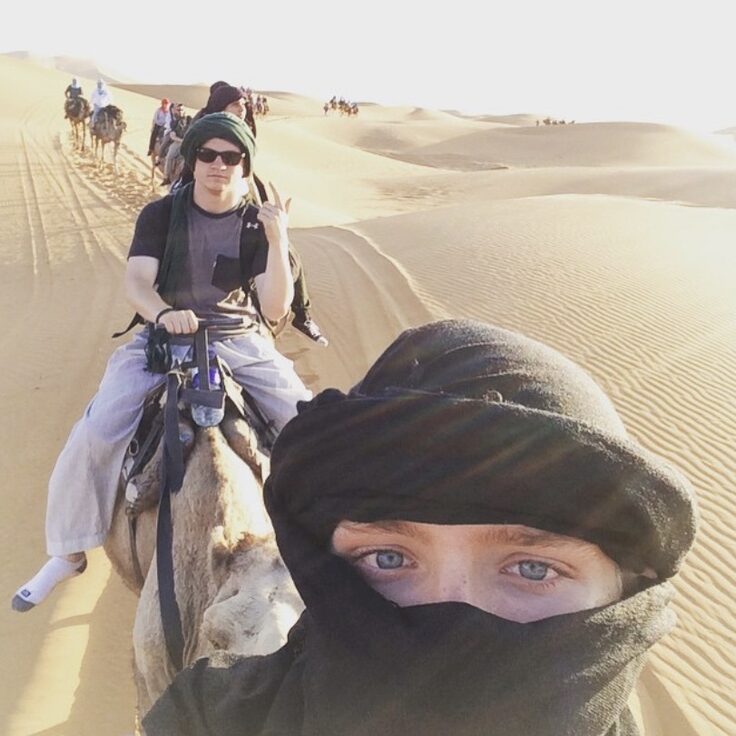
When I’m physically traveling, my parents generally only offer input if I ask for advice, or if I’ve told them that I’m going to do something they deem “risky”—for example, bungee jumping or a guided trip into the Sahara (this one was risky because I tried to organize it before going to Morocco and could only find offers for guided trips where I would be the only guest).
I don’t tell them everything, like how I accidentally hitchhiked from Vimy Ridge to Arras after missing the last bus back into town and was fully prepared to walk the 10.8 km; or that when I was stranded in Belgium after missing the last train, I slept on the couch of a random guy I met at a bar. I think they’re always worried about me, and that’s okay. I try to conduct myself with respect for whatever culture and place I find myself in. Sometimes respect isn’t enough. Sometimes it exposes you to sides of society you aren’t familiar with, and that’s a simple fact of traveling.
When I decided to go to Morocco on my own, my parents were very worried. Morocco is a Muslim country, English is not their first language, and the cultural perspective towards women is completely different from Canada’s. But my parents also couldn’t do anything but tell me to be careful. I felt prepared for traveling in Morocco. I armed myself, in hindsight, with some pretty stingy knowledge that I had gleaned from a travel blog. It said to buy first-class train tickets—which I did, but accidentally sat in second class until the conductor moved me to first, closing me off in one of those booths with a sliding door that reduced the opportunity for people-watching. I traveled during the day and hardly ever went out at night. I wore a ring on my thumb that I switched to my ring finger when I had been catcalled and followed for longer than was comfortable. I always wore clothing that covered my shoulders and legs down to my ankles.
The only time these tricks didn’t work was when I went to a beach in Tangiers. I didn’t intend to swim, and instead, I sat fully clothed eating Khobz and avocado I’d gotten from the market. I was aware of a group of young men sitting about 30 feet away, but didn’t engage with them.
They egged each other on until one came over, speaking to me in English, French, Spanish, Arabic, and many other languages. I didn’t respond, pretending to read instead. Eventually, he gave up and went back to his friends. He came back, and I responded when he asked me what I was reading. We talked for a while, and he invited me to a party.
I made up a story about my friend who was sick back at the hostel, saying I might join later, but that I had to check on my friend first. He said I should bring my friend. I thanked him and left—going back to my hostel, where no one was sick in bed waiting for me. I brought my high school best friend with me in spirit to Morocco. I lied to that man because it was safer than telling him I was on my own.
It doesn’t always turn out the way you plan. When you travel alone, there is always a moment—it’s often brief and fleeting—when you have to make a choice about how to handle any situation you find yourself in. One of my blessings in disguise occurred in October 2017 when I spent a full morning at a B&B in Bunratty, Ireland, rejigging my entire trip because I wasn’t able to rent a car for the price I planned to. I was 24 years and 11 months old—crucially, not 25—and it would cost 100 euros extra a day to rent a car, just for the insurance. I took trains and buses instead, and did my entire trip in the opposite direction. I lucked into being in Cork for the Jazz Festival and Galway for a bank holiday, which involved horse racing and drunken revelry—both of which I would have missed had I gone about my trip as originally planned.
I cried that morning, feeling like nothing was going right, not knowing what I was going to do, feeling like all the planning I’d done before arriving in Ireland was useless. I felt useless. But it turned out to be an amazing trip. I saw things I wouldn’t have, experienced things I wouldn’t have, and met people I never would have had the opportunity to meet had my original plans been successful. It didn’t feel like a blessing when I was in the middle of changing my entire trip, but in hindsight, it’s one of my favorites.
The risk of being in the wrong place at the wrong time happens even when you’re at home. One of the scary, beautiful, and intimidating things about traveling alone is that if you fuck up, you generally have no one to blame but yourself. It’s scary because we function in our everyday lives, giving blame to others instead of accepting fault. It’s intimidating because strangers are difficult to predict, and they force you to learn things about yourself that aren’t always flattering. We’re all learning about ourselves, every single day. Traveling alone is a forced change of perspective. That. Is. Beautiful.